Marketing website · 2026
ReBuzzPlugin landing page
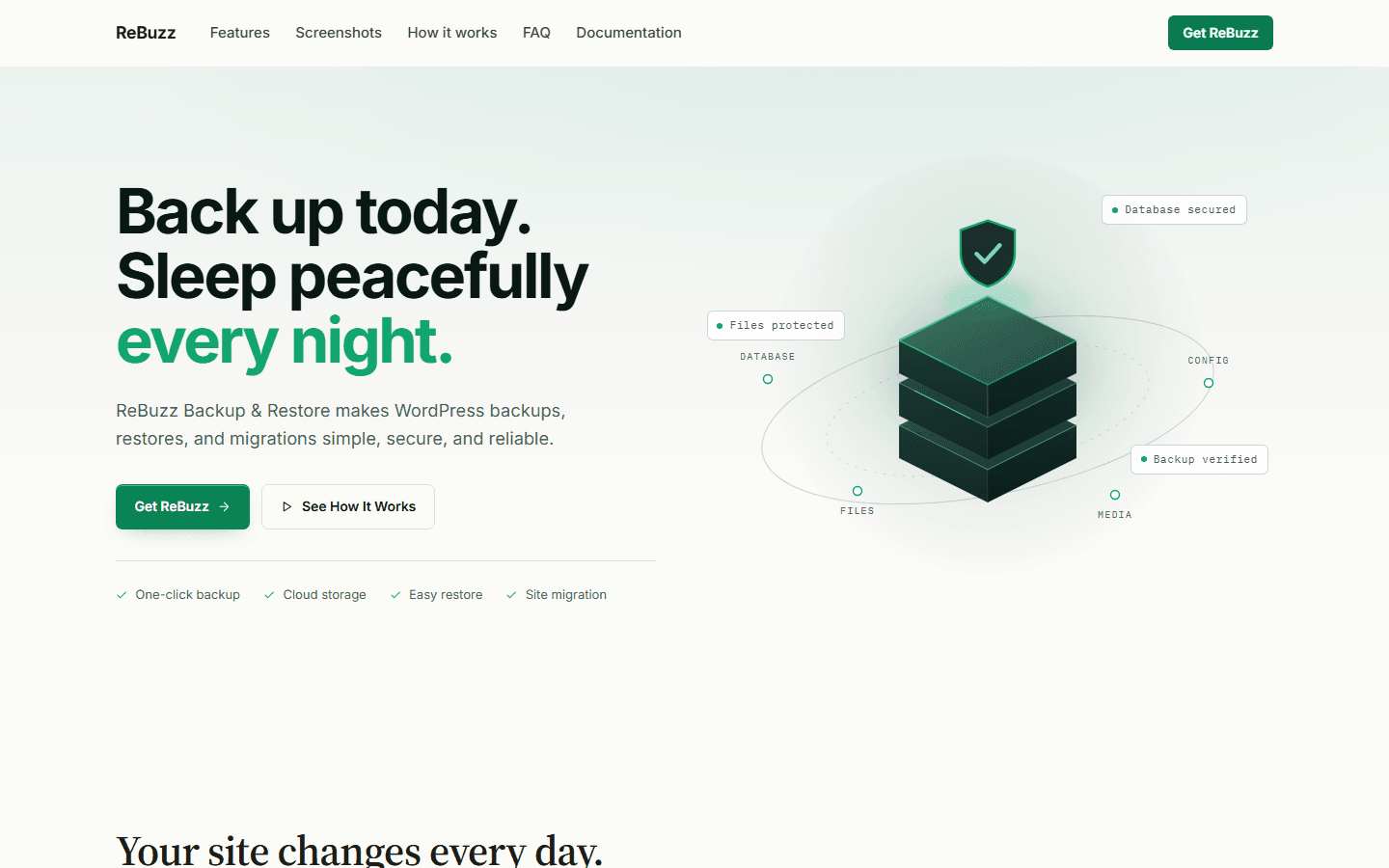
This is the public website for ReBuzz Backup & Restore, the WordPress plugin I built during my internship. It explains what the plugin does to someone who has never seen it, walks through real screens from wp-admin, answers common questions, and hands visitors the plugin zip from a download page with requirements and install steps. It is a static site with no framework: plain HTML, a hand-written CSS design system and a small amount of JavaScript.
The problem
The plugin needed a home outside wp-admin: a page that explains it to someone who has never installed it, and a dependable place to download it. Backup tools are easy to oversell, so the aim was a page that stays specific: say what the plugin does, show the real screens, and let people get it in a couple of clicks.
What is on the page
An illustrated backup vault in the hero leads into the problem, eight features, a tour of real plugin screens, a three-step walkthrough (including moving a site to a new host), where backups are stored, and an FAQ. Every Get ReBuzz button opens a download page with the plugin zip, the WordPress and PHP requirements, and install, FTP and update instructions.
Hand-written CSS, on purpose
The brief suggested Tailwind, but its CDN build generates styles in the browser at load time and is not meant for production. For a single bespoke page I wrote the CSS by hand instead: every colour, size and spacing value is a CSS variable, the same tokens drive a dark theme, and every text colour pair meets WCAG AA contrast. A Tailwind config mirrors those tokens, so switching to a compiled build later is a mechanical change rather than a redesign.
Accessibility and shipping
The FAQ accordion follows the WAI-ARIA pattern with arrow-key navigation, the mobile menu keeps focus inside it and closes on Esc, and the only ambient motion switches off for visitors who prefer reduced motion. The site deploys to Cloudflare Workers on every push to main. A small build script copies only the public pages and assets into a dist folder, so the repository's .git folder and internal notes are never served.