Full-stack AI application · 2026
RecallAILocal AI study workspace
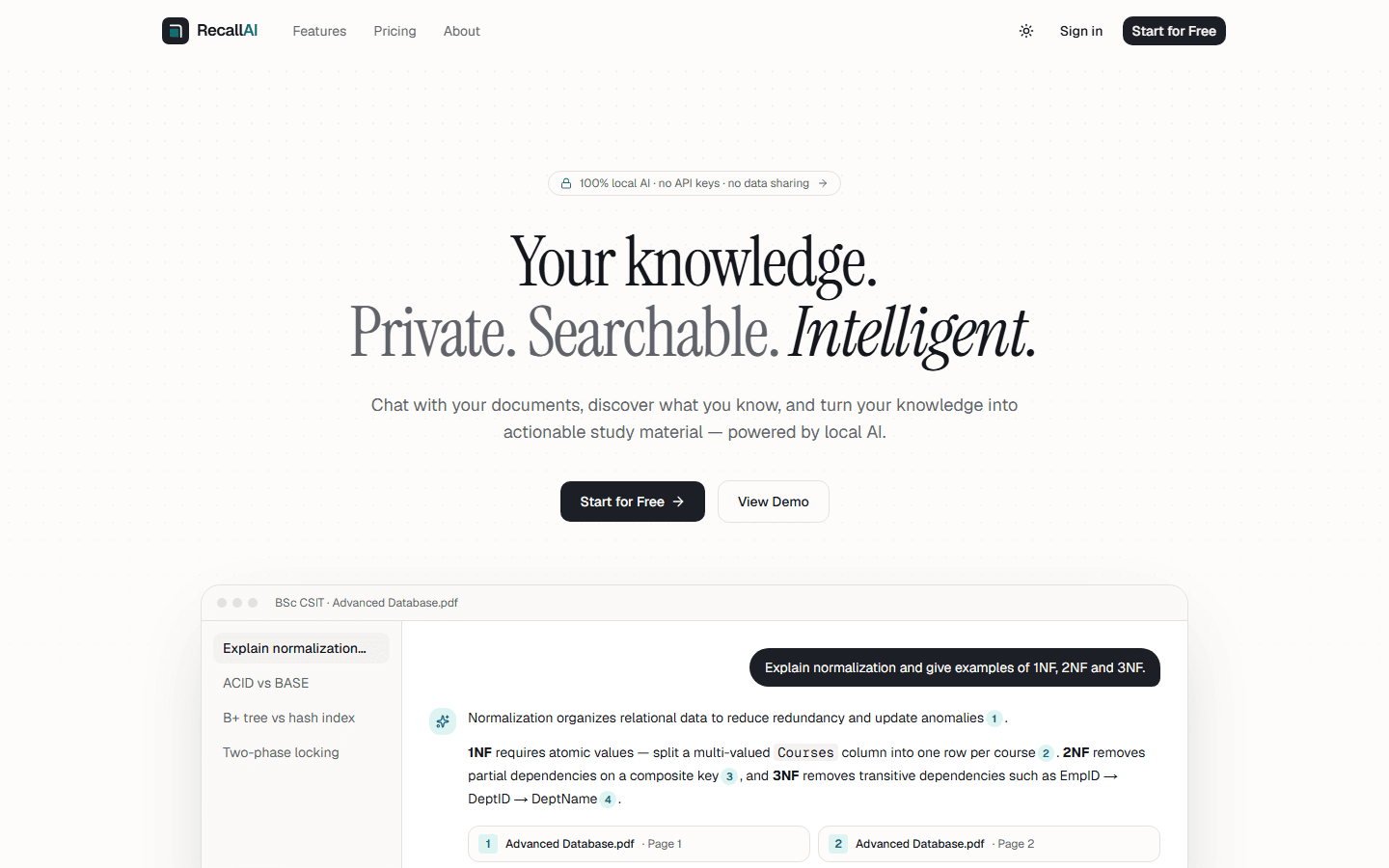
RecallAI is a knowledge and study workspace that runs entirely on your own machine. You upload PDFs, Word files, text or Markdown into a knowledge base, then search them by meaning, ask questions and get streamed answers that cite the page they came from, or turn the material into summaries, flashcards, quizzes and timed mock exams. Every model runs locally through Ollama, so no document or question is sent to a third-party AI service, and it costs nothing to run.
The problem
Studying from a stack of PDFs means searching for half-remembered phrases and rereading chapters to find one definition. AI chat tools can help, but they want your notes uploaded to someone else's servers, often on a paid plan, and they answer confidently with nothing to check against. I wanted the useful part (ask a question, get an answer drawn from your own material) on two conditions: the documents never leave the machine, and every answer shows where it came from.
How an answer is made
When a document is uploaded, a Celery worker extracts its text page by page, cleans it, splits it into overlapping chunks of about 600 tokens and embeds each one with nomic-embed-text, storing the vectors in PostgreSQL with pgvector. A question is embedded the same way, matched against an HNSW index limited to the user's workspace, reranked, and dropped if nothing clears a relevance threshold. The passages that survive go into a grounded prompt labelled by source and page, and the answer streams back from llama3.2 over Server-Sent Events with numbered citations. An optional hybrid mode adds PostgreSQL full-text search and merges the two rankings with reciprocal rank fusion.
Built around one interface
No view talks to Ollama directly. Every model call goes through two small interfaces, one for generation and one for embeddings, so a request passes from the view through a chat service and the RAG pipeline (retriever, reranker, prompt builder) before it reaches a provider. That boundary is what makes the project testable: the 96 backend tests swap in a hashing embedder and a scripted model, so parsing, chunking, pgvector search, prompts, citations and streaming all run for real without a model installed. A Playwright suite then runs the whole flow against real local models, from sign-up to a scored quiz.
Honest about its limits
A 3-billion-parameter model on a CPU is slow (the first words take about five seconds, a full quiz one to three minutes) and less capable than a hosted model, which is why every answer carries citations and a reminder to check the cited pages. Scanned PDFs cannot be read yet because there is no OCR, and the app is not deployed anywhere: it is meant to run on the machine that holds the documents.