Full-stack SaaS platform · 2026
ReachBuzzWhatsApp messaging platform
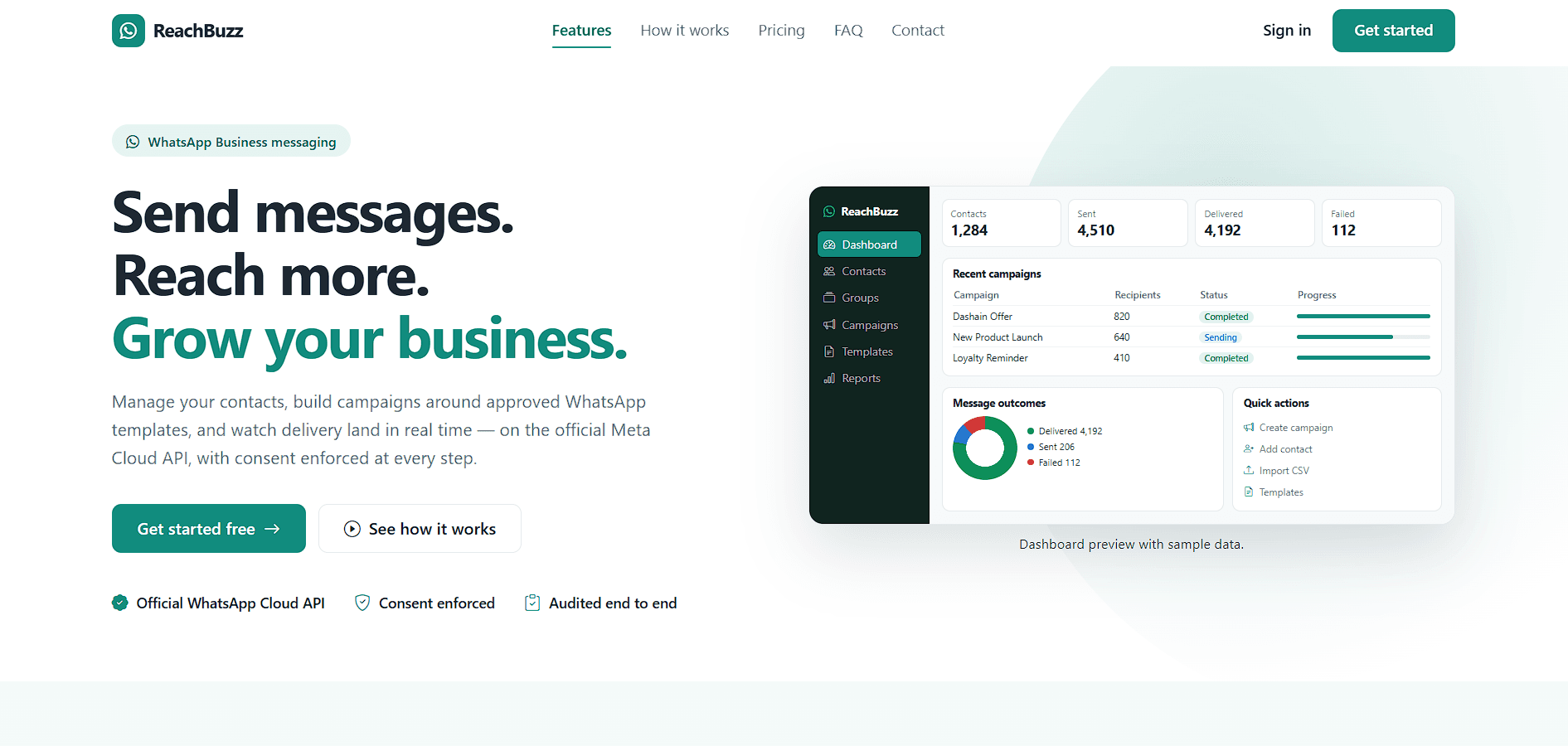
ReachBuzz lets a business send WhatsApp campaigns to its customers and see what happened to every message. An operator imports contacts with their consent recorded, groups them into audiences, builds a campaign around a template Meta has approved, previews it and launches it. Sending runs in a background queue, one job per recipient, and Meta's webhooks stream delivery, read and failure events back to a live campaign page. It started as a tool for a single business and grew into a multi-tenant SaaS with sign-up, plans, invoices, a staff backoffice and an SMS channel.
The problem
Businesses want to reach customers on WhatsApp, and the quick ways to do it in bulk (automating WhatsApp Web, unofficial libraries, scraped numbers) break Meta's rules, get numbers banned and ignore whether anyone agreed to be messaged. ReachBuzz takes the slower route on purpose: it sends only through Meta's official Cloud API, only with templates Meta has approved, and only to contacts whose consent is recorded. A STOP reply opts someone out, and every consent change goes to an append-only audit log.
The sending pipeline
Launching a campaign creates one message row per recipient up front, then queues one Celery job for each once the transaction commits, so a worker never sees a row that does not exist yet. Every job starts by claiming its row with a conditional UPDATE: if two workers pick up the same message, one wins and the other stops. A token bucket in Redis, refilled and drawn from in a single Lua script, keeps all workers together under the account's sending limit. Temporary failures retry with exponential backoff and jitter, while permanent ones (a number that is not on WhatsApp, say) are recorded straight away. Before any of that, a preflight check confirms the queue is reachable, so a campaign is never left stuck halfway.
From one business to many
Once the single-business version was finished, I turned it into a SaaS in nine stages, each on its own branch and checked against the full test suite before the next one began: organisations with tenant isolation, sign-up with email confirmation, plans and usage limits, invoices, per-organisation WhatsApp credentials encrypted at rest, a billing area, a staff backoffice, a versioned API and an SMS channel. Payments go through an abstract provider, and issued invoices are numbered without gaps and never change.
Nothing invented
The app refuses to show what it cannot back up. The dashboard shows a dash rather than a made-up statistic, a plan with no price reads Pricing on request, and a test follows every link on the landing page and fails on a 404. The same goes for this write-up: the project has about 1,300 automated tests and a mock provider that simulates the whole sending path, but it has not yet sent through a real WhatsApp Business Account, and no real payment or SMS gateway is connected. Those need business accounts and credentials rather than more code.